4. The Storytellers
Let me tell you a story.
What do we expect when someone says, “let me tell you a story”? This has been the question that I kept mulling over in my mind in the past few weeks, since I arrived in Shenzhen with my cameraman J in September, determined to tell a story about the city and its people. I was anxious before the trip—to the extent that my wisdom tooth flared up, partly due to the responsibilities towards a collaborator who was a first-timer to China, but mostly from the weight of having to tell a good story. We had chats before we embarked on our “big China trip” about what the story is, knowing perfectly well that all we’d be able to come up with would be at best placebos for our anxiously creative minds, a pretend itinerary.
In Walter Benjamin’s famous essay on Nikolai Leskov, “The Storyteller,” he wrote:
“Less and less frequently do we encounter people with the ability to tell a tale properly. More and more often there is embarrassment all around when the wish to hear a story is expressed. It is as if something that seemed inalienable to us, the securest among our possessions, were taken from us: the ability to exchange experiences.”
This essay got read and mentioned in many of the literature seminars I took during my PhD studies as one that dealt with the modern crises surrounding telling a story. What I got out of those esoteric reading sessions back then was that times have changed, so has the way we talk about our times, and so, the storyteller has become something remote from us, certain way of recounting experiences has fallen in value, and thereby the storyteller is dead.
But that might be a misinterpretation of Benjamin’s text in that it was reading too much into his nostalgia of the “good old days.” What the essay reads to me today, as I embark on a storytelling journey myself, is a confession of love for stories, for the sustained effort people used to put into the craft of passing on experiences from mouth to mouth.
When I was around five or six, I was given by my parents tapes of old comedic tales. As the only child in our household who constantly yearned for playmates, I would listen to the stories again and again, and took the adult comedians in the tapes as my imaginary playmates. I would rewind the tape back to the beginning of a story I just finished, and make sure that I didn’t miss a single detail of it. Not just the plots of the stories, but each sentence, each word being used, and the tone in which a word was being spoken, so that I could retell the stories in as accurate a manner as I could in front of family guests. I would sometimes mistake plots, inadvertently reverse the order of events, but I would never miss the tones in which a story was being told. The tones did the tricks.
This way, as a five-year-old I got to pretend to have gone on trips to far away places with strange sounding names, to have met people whom I’d never met before and regarded them as my equals, and to have seen the world and shown it to the less well-traveled. But my comedian friends living in those tapes were real. They had told me good stories. They had kept my company loyally and taught me the joy of being a storyteller by retelling experiences I’d never had.
Now, let me try one more time to tell you a story. Let me try to recount for you our journey of making a documentary.
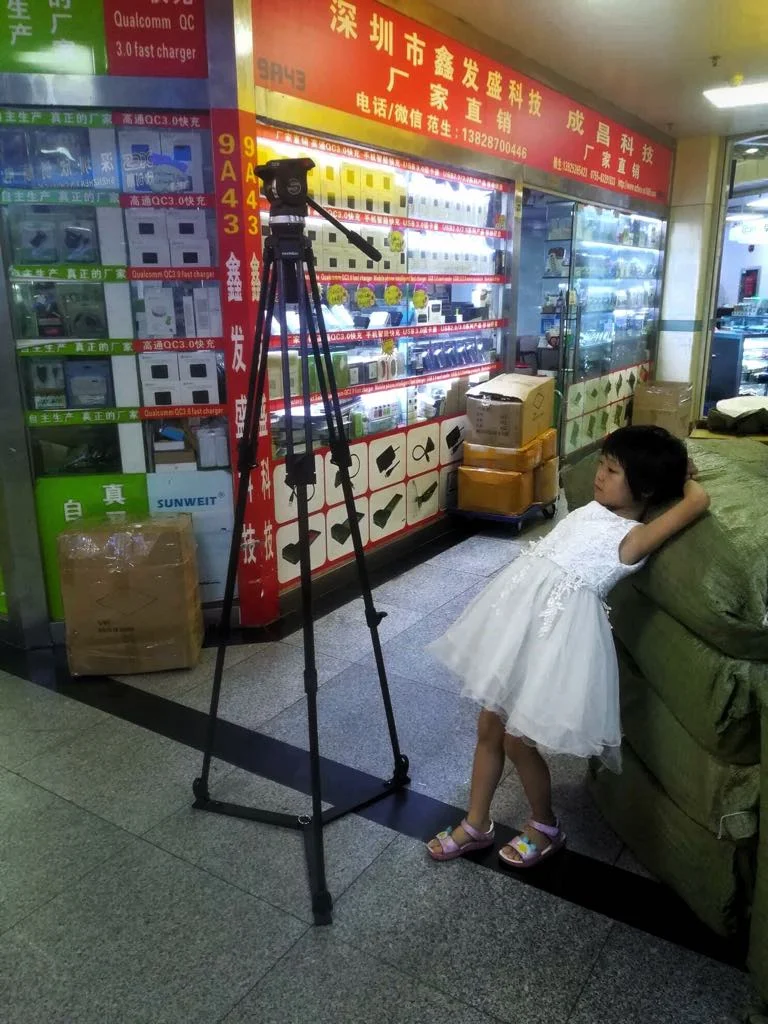
For the past month, we were always waiting for something to happen. We spent about a week in the SEC Electronics Market waiting for the lights in the market to be turned off at 6:30pm. We waited for the cleaning lady to pass by the exact corner as the day before. The day after Typhoon Mangkhut hit Shenzhen, Huaqiangbei’s streets were still damp and charmingly reflective. We set the camera up and waited for pedestrians and guys with shipping carts to walk by the reds, greens, and blues spritzed on the ground. We sat by children who hung out in the markets, and waited with them for the working day of the parents to be over, and them to be taken home for a late dinner.
Making a documentary consists of a series of waiting. We often have shooting days where nothing works as we expect. In documentary, you lose your sense of order of events, as if nothing happens at all through your lens, and all of a sudden, everything happen all at once. And you are never sure whether the nothing that happens or the everything would actually end up being an integral part to your story. So you push the record button, wait around, light a cigarette, take a sip of water, look into the tired eyes of your teammate, and smile with a nod, tacitly informing your teammate that you have not fallen asleep. But to the outsiders, you will look as if you’ve fallen so much in love with that which is in the shot.
Often in a documentary, you don’t know what you are waiting for. But you are waiting nonetheless, faithfully. Only some days, weeks, or even months later, you look at the footage in a completely different time-space where your eyes are refreshed again to see what’s being played on the screen, only then you will see what you have waited for. And then you press the stop button, sit there for a long time, close your eyes, watching the morning, the afternoon, the hour, replay in your head. You hear the breathing of the person waiting in silence next to you. The chaotic times are over. And you realize, you might have found traces of a story.
This is our journey in a nutshell. Parts of it have already happened, the rest are hopeful speculations. A pretend itinerary. The truth is, I am in the process of telling you a story, but I don’t know how to tell it yet. What needs to be added, subtracted, twisted slightly, and added a few revealing details, some salt and pepper. All I know is that one tells a good story if one keeps telling it.
In Benjamin’s essay, he used Paul Valéry’s observation of how craftsmanship has become outdated to make a point about the loss of sustained effort in storytelling.
“’This patient process of Nature,’ Valery continues, ‘was once imitated by men.’ Miniatures, ivory carvings, elaborated to the point of greatest perfection, stones that are perfect in polish and engraving, lacquer work or paintings in which a series of thin, transparent layers are placed one on top of the other—all these products of sustained, sacrificing effort are vanishing, and the time is past in which time did not matter. Modern man no longer works at what cannot be abbreviated.”
Maybe it would be impossible to rewind that, to return to a time when time did not matter, where sustained effort was the norm. In a time like that, waiting wouldn’t be waiting; it would be just adding another thin, transparent layer to the craft of people-observation.
Before the trip, friends and acquaintances have asked me what the story of my documentary is. I would give them a version of the story based on the proposal I wrote for funding applications, but knowing deep down that that wasn’t the story. Many would say that they liked it, and would even ask meaningful questions about it regarding theories, history, and facts. But the truth is, what I had written in the proposal wasn’t the story. I knew it, J knew it, my producer F knew it, my whole team knew it. We were merely at the very beginning of a journey in search for a story. The story is yet to be told.